We are history educators who are devoted to helping teachers working in urban schools. We emphasize culturally relevant curriculum and research-based practices designed to meet the needs of a diverse student body. We work with schools and districts to customize professional learning that is hands-on and collaborative. This customized professional learning addresses the instructional shifts found in the History-Social Science Framework: Content, Literacy, Inquiry, and Civics.
Professional Development
K16
Collaborations
How do we ensure that our courses and curriculum reflect the latest historical scholarship?
Curriculum
Writers
How do we ensure that our history curriculum reflects our community so that our students are engaged and empowered?
Course
Design
What does my course look like when it’s redesigned through the lens of inquiry, literacy, and civic engagement?
Lesson
Study
How do we build a culture of collaboration and data analysis in order to improve our teachers and engage our students?
Ethnic
Studies
How do we empower students to become engaged citizens and change makers in their communities?
Literacy
Workshops
How do we ensure that our students become critical thinkers, readers, and writers?
Examples of our offerings include:
Reading and Writing in the Social Studies Classroom
Literacy
- Annotation strategies for use with primary and secondary sources. We provide the source sets for this work and use the new English Language Arts Development Standards to design model activities.
- Writing strategies to support the development of evidence-based argumentative writing.
Speaking and Listening in the Social Studies Classroom
Literacy, Inquiry, and Civics
We emphasize strategies that promote small group collaborative conversations that enable all students to participate in discussions that promote historical thinking, literacy, and civic engagement.

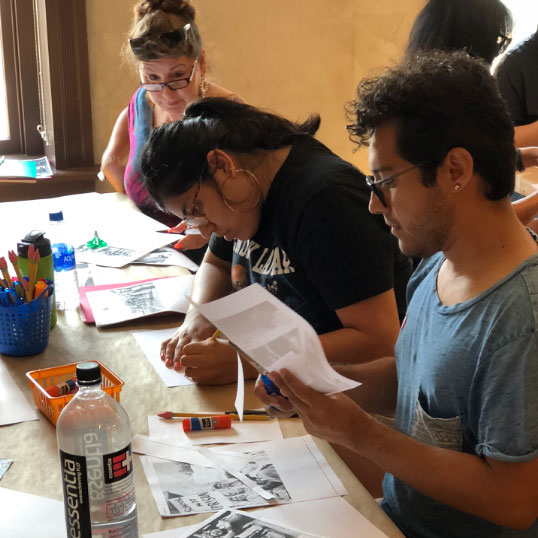
Course Design
Literacy, Inquiry, and Civics
Informed by Wiggins and McTighe’s Understanding by Design model, the History-Social Science Framework, and Bruner’s “spiral curriculum” research. This process can include
- Creating year-long (“Essential”) questions and year-long historical literacy goals
- Generating unit-level historical questions that directly connect to the year-long question.
Curriculum Design
Inquiry, Literacy, Content, and Civics
- This can include: Planning for the Common Core. Working with teachers to develop pacing guides using backwards planning to embed Common Core skills, essential questions, and historical investigation/inquiry activities.
- Integrating educational technologies (edtech) into social studies/history classroom.
- Creating history investigations/inquiry lessons in collaboration with teachers to promote historical thinking and the development of skills aligned to the California Standards.
- Introduction to the History Blueprint as a model of Common Core based curriculum.
Ethnic Studies
Civics, Literacy, Content, and Inquiry
Our Ethnic Studies model is research-based and guided by an emphasis on Identity, Community, and Content. We believe that the best Ethnic Studies program is one that is organic and tailored to its community. We also believe that the best way to sustain an Ethnic Studies program is to support the community’s teacher leaders so that they can take the lead in its design and implementation
One-on-one Instructional Support
- Utilization of Lesson Study as a process to improve instruction and student outcomes.
- Development of teacher leaders.
- One-on-one coaching
- Modeling a lesson