

Preparing Advanced Placement Students &
UCLA Center X – AP Readiness 2023-2024 has concluded. Thank you for a great year of student learning and educator professional growth. Please check back in August 2024 for information about the 2024-2025 year.
UCLA AP Readiness was conducted primarily as a Virtual Program for 2023-2024. Each Program Strand (Humanities & STEM) had one In-Person date conducted on the UCLA campus. Thank you for your participation and we look forward to another great year!
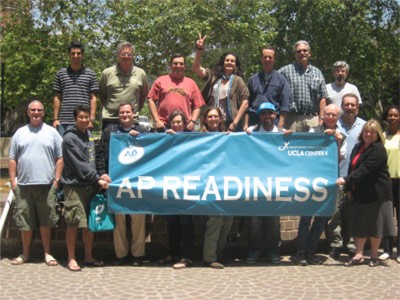
Equity & Access to high-level, rigorous instruction in Advanced Placement is the mission of AP Readiness. The AP Readiness Program is designed with two interconnected goals in mind. The program aims to improve the teaching abilities of AP instructors while simultaneously giving students the skills they will need to be successful in college level classes. AP Readiness allows students to work with master instructors, who prepare them for the rigorous curriculum that they will face in AP courses. Concurrently, their AP teachers observe and learn from the master instructors, gathering a framework for how to successfully conduct an AP course. This unique program allows for students and teachers to learn together. Both teachers and students also become an essential part of a network of AP support and excellence.
Student Registration & Educator Registration for 2024-2025 will open in August 2024.
AP Readiness Registration Page – Click for AP Readiness STUDENT & Educator Registration for the 2024-2025 Academic Year will open in August 2024.
AP Readiness STEM Subjects: Biology, Calculus AB, Calculus BC, Chemistry, Computer Science Principles, Environmental Science, Physics 1 & Statistics
AP Readiness HUMANITIES Subjects: English Language, English Literature, Government, Psychology, U.S. History, World History, Spanish Language & Spanish Literature
2024-2025 Dates
APR STEM – To be posted in August 2024.
APR HUMANITIES – To be posted in August 2024.
 Highlights
- Professional Development supporting math, science, and computer science teachers for AP Math, Science and Computer Science courses
- Professional Development supporting English, Spanish and Social Studies teachers for AP English, Spanish and Social Studies courses
- Workshops providing students with the skills necessary to be successful in college level classes and Virtual hands-on AP activities
- Formation of a network of learners allowing communication between teachers and students from various neighborhoods